| Opening date | July 17, 1976 |
| Closing date | August 1, 1976 |
| Participation | 94 nations 6,084 athletes (1,260 women, 4,824 men) 414 athletes representing Canada 2,661 escorts 196 events 3,195,170 spectators 1 billion television viewers |
| Official Opening | Her Majesty Queen Elizabeth II |
| Lighting of the Olympic Flame | Stéphane Préfontaine (16 years old) and Sandra Henderson (15 years old) |
| Olympic Oath | Pierre St-Jean (weightlifting) |
| Judges and Officials Oath | Maurice Forget (athletics) |
Sports on the program (21)
Aquatics*
Archery
Athletics
Basketball
Boxing
Canoe/kayak
Cycling
Equestrian
Fencing
Field hockey
Football
Gymnastics
Handball
Judo
Modern pentathlon
Rowing
Sailing
Shooting
Volleyball
Weightlifting
Wrestling
*including diving and water-polo
No demonstration sports
27 competition sites
Security
Approximately 16,000 people (police and military)
Medal chart
Nation |  Gold |  Silver |  Bronze |
|---|---|---|---|
| 1. USSR URS | 49 | 41 | 35 |
| 2. German Democratic Republic GDR | 40 | 25 | 25 |
| 3. United States of America USA | 34 | 35 | 25 |
| 4. Federal Republic of Germany FRG | 10 | 12 | 17 |
| 5. Japan JPN | 9 | 6 | 10 |
| 6. Poland POL | 7 | 6 | 13 |
| 7. Bulgaria BUL | 6 | 9 | 7 |
| 8. Cuba CUB | 6 | 4 | 3 |
| 9. Romania ROM | 4 | 9 | 14 |
| 10. Hungary HUN | 4 | 5 | 13 |
| 11. Finland Fin | 4 | 2 | 0 |
| 12. Sweden SWE | 4 | 1 | 0 |
| 13. Great Britain GBR | 3 | 5 | 5 |
| 14. Italy ITA | 2 | 7 | 4 |
| 15. France FRA | 2 | 3 | 4 |
| 16. Yugoslavia YUG | 2 | 3 | 4 |
| 17. Czechoslovakia TCH | 2 | 2 | 4 |
| 18. New Zealand NZL | 2 | 1 | 1 |
| 19. Korea KOR | 1 | 1 | 4 |
| 20. Switzerland SUI | 1 | 1 | 2 |
| 21. Democratic People’s Republic of Korea PRK | 1 | 1 | 0 |
| 22. Jamaica JAM | 1 | 1 | 0 |
| 23. Norway NOR | 1 | 1 | 0 |
| 24. Denmark DEN | 1 | 0 | 2 |
| 25. Mexico MEX | 1 | 0 | 1 |
| 26. Trinidad and Tobago TRI | 1 | 0 | 0 |
| 27. Canada CAN | 0 | 5 | 6 |
| 28. Belgium BEL | 0 | 3 | 3 |
| 29. Netherlands NED | 0 | 2 | 3 |
| 30. Portugal POR | 0 | 2 | 0 |
| 31. Spain ESP | 0 | 2 | 0 |
| 32. Australia AUS | 0 | 1 | 4 |
| 33. Islamic Republic of Iran IRI | 0 | 1 | 1 |
| 34. Mongolia MGL | 0 | 1 | 0 |
| 35. Venezuela VEN | 0 | 1 | 0 |
| 36. Brazil BRA | 0 | 0 | 2 |
| 37. Pakistan PAK | 0 | 0 | 1 |
| 38. Puerto Rico PUR | 0 | 0 | 1 |
| 39. Thailand THA | 0 | 0 | 1 |
| 40. Austria AUT | 0 | 0 | 1 |
| 41. Bermuda BER | 0 | 0 | 1 |
The medal charts are provided for information purposes only. These results are official and are taken from the official report, a document published for each Olympic Games by the Organizing Committee. The ranking of nations is established based on the number of medals obtained, with gold medals counting for more than silver or bronze. In addition, a team win is counted as 1 medal.
Medals of the 1976 Games
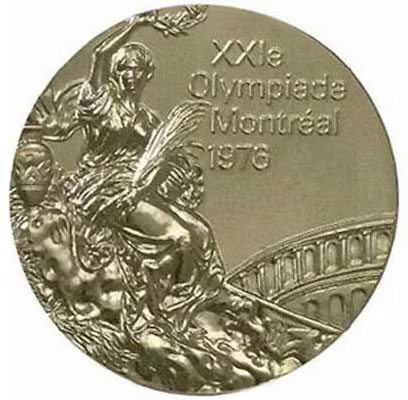
On the front, there is a drawing by Giuseppe Cassioli, designed for the 1928 Amsterdam Games. The main symbols are Victory, Fraternity and Universality. The back is purposely sparse. It includes a stylized crown of laurels–a symbol of victory since the Games of Antiquity–and the Emblem of the Montréal Games.
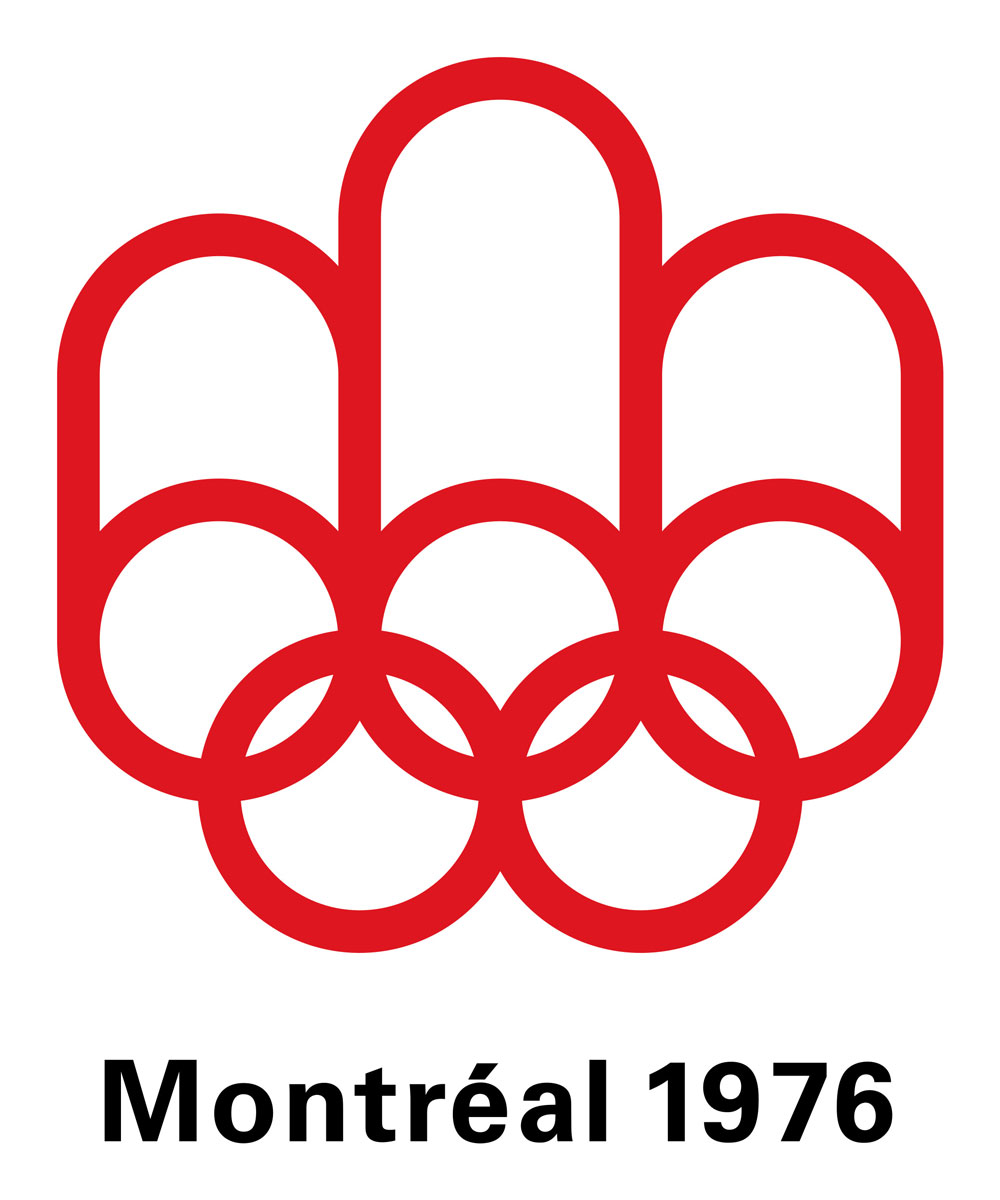
Emblem of the 1976 Games
The Emblem is made up of the Olympic rings mounted on an Olympic podium, which is also the graphic representation of the letter “M”, Montréal’s initial. In the middle is the athletics track, a privileged place at the Games. This Emblem evokes the universal fraternity of the Olympic ideal, the glory of the winners, the chivalrous spirit of their battles and the ascension of Montréal to Olympic city. The Emblem was designed by graphic artist Georges Huel, who, along with Michel Dallaire, also designed the Torch.
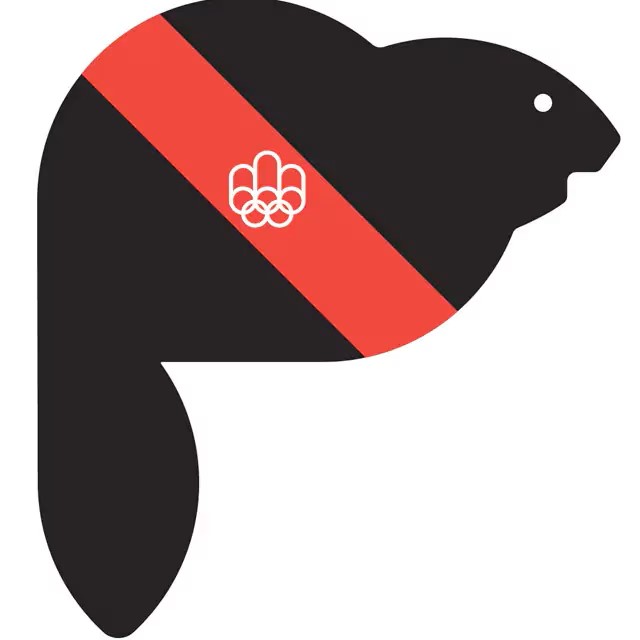
Mascot of the 1976 Games
Baptized “Amik”, a term taken from the Algonquin for “beaver”, this animal was chosen as the Mascot because it is recognized for its patience and hard work. It also played an important role in Canada’s development, when fur trading was one of the primary activities in North America. A great Canadian national symbol, the beaver is found on certain coins and stamps. The Mascot had a red belt bearing the Olympic Emblem and symbolizing the ribbon to which the winners’ medals were attached.
Music
The music was taken from the work of composer and pianist André Mathieu (1929-1968). The musical director and orchestra conductor was Victor Vogel, assisted by Art Philips, a specialist in orchestral arrangements.
A virtual fire
For the first time ever, the Olympic Fire arrived from Greece electronically. It was sent as coded impulses carried by telephone cable to a transmitter and directed to an Intelsat satellite. It was then forwarded to a receiver in Ottawa. There, a laser beam returned it to its original form.
Absence of the Africans
In spite of the absence of 22 African nations, which, led by Tanzania, were boycotting the Games to protest a recent South African tour by the New Zealand national rugby team, the 1976 Olympic Games featured excellent competitions.
Soviet domination
The Soviet team finished ahead of all other countries with 49 gold, 41 silver and 35 bronze medals.
Medal standings
Seven socialist countries made it to the top 10 in terms of medal standings, with the USSR and GDR leading the way.
Canada finished in 13th place in the standings for number of medals per country, earning 11 medals (5 silver and 6 bronze).
The performance delivered by Canada’s swimmers deserves special mention, for they captured 8 of Canada’s 11 medals.
A medal for Bermuda
Bermuda became the least populated country (53,500 inhabitants) to obtain a medal at the Summer Olympics, thanks to Clarence Hill, who won the bronze medal in boxing, in the heavyweight class.
Artificial grass
Field hockey was played on artificial grass for the first time.
More events for the women
There were more events for the women with the appearance of women’s basketball, handball and rowing.
Queen Nadia
Romanian gymnast Nadia Comaneci was the first gymnast in Olympic history to obtain a perfect 10. She obtained her first 10 on the uneven parallel bars, and then the judges awarded her 6 more perfect scores.
Super Viren
Finnish runner Lasse Viren pushed the world’s greatest distance runners to their limits by winning the 5,000-metre and 10,000-metre races for the second time in a row. He took part in the marathon and tried to repeat Emil Zatopek’s 1952 treble, but he finished fifth on his first marathon try.
Diving Italian style
With his victory in the high dive, Italian Klaus Dibiasi became the first diver to win 3 successive gold medals and to obtain medals in 4 different Olympic Games.
Canadian Olympic medallists
| Silver | |
|---|---|
| Cheryl Gibson | Swimming, women’s 400 m individual medley |
| Greg Joy | Athletics, men’s high jump |
| Michel Vaillancourt | Equestrian, Grand Prix jumping, individual |
| John Wood | Canoeing, men’s C-1 500 m |
| Stephen Pickell Graham Smith Clay Evans Gary MacDonald | Swimming, men’s 4 x100 m medley relay |
| Bronze | |
|---|---|
| Nancy Garapick | Swimming, women’s 100 m backstroke |
| Nancy Garapick | Swimming, women’s 200 m backstroke |
| Becky Smith | Swimming, women’s 400 m individual medley |
| Shannon Smith | Swimming, women’s 400 m freestyle |
| Gail Amundrud Barbara Clark Becky Smith Anne Jardin | Swimming, women’s 4 x 100 m freestyle relays |
| Wendy Hogg Robin Corsiglia Susan Sloan Anne Jardin | Swimming, women’s 4 x100 m medley relay |
Opening ceremony – Highlightss
- 76,433 spectators filled the Stadium.
- Nearly 8,200 people took part in the parade.
- Close to half a billion television viewers watched the ceremony.
- Her Majesty Queen Elizabeth II of England officially declared the Games open.
- Mayor Jean Drapeau received a standing ovation.
- Eighty young girls released carrier pigeons in a message of friendship to the people of the world. The gesture recalled the procession of virgins that accompanied the athletes in ancient times. The number was in honour of the 80th anniversary of the first Games of the modern era.
- Two young athletes, an Anglophone and a Francophone (symbolizing the two founding peoples), Sandra Henderson of Toronto, and Stéphane Préfontaine of Montréal, carried the flame and lit the cauldron in the centre of the Stadium.
- Québec weightlifter Pierre St-Jean swore the Olympic Oath on behalf of all the athletes.
- Judge Maurice Forget (athletics) swore the Judges and Officials Oath.
Closing ceremony – Highlights
- 76,433 spectators filled the Stadium.
- The closing ceremony was a spectacular extravaganza.
- Five hundred young girls cloaked in white performed a choreographed routine in which they formed the colours and rings of the Olympic flag.
- To underscore the fellowship and unity of Olympic sport, the athletes entered without being grouped separately by nationality. They were accompanied by over 500 Amerindian people in festive costumes, and entered the five rings formed by the young girls; they then erected tents in the colours of the Olympic rings.
- Once the Games were declared closed, the Olympic flag was lowered as the farewell song was sung. Eight athletes carried the flag out of the Stadium.
- The Olympic Flame was extinguished; time to make way for the next Games. On giant screens, live from Moscow, dancers and singers performed a short number and presented a gigantic candle on the screen.
- The crowd in the Stadium then waved candles or light sticks as a gesture of friendship, marking the end of the XXI edition of the Olympic Summer Games.
- For further details, visit the International Olympic Committee site.